
Reviews
This game stands out for its focus on pure creativity without pressure. The pattern tools are intuitive, and the two characters offer just enough variety to keep designs interesting. The lack of timers or scores makes it a calming activity for all ages. Saving outfits adds a sense of accomplishment, though sharing options are limited. Overall, it is a well-crafted creative tool that prioritizes fun over competition.
About this game
Core Design Experience
Players step into a vibrant workshop where fabric becomes a canvas. The game focuses on applying colorful patterns to clothing items using a straightforward drag-and-tap system. Each piece of clothing starts as a blank slate, waiting for the player's choice of spirals, stripes, or splash effects. The color palette offers a wide range of shades, from soft pastels to bright neon tones. Mixing these colors on fabric creates gradients and blends that feel fresh and unpredictable. The process encourages experimentation because there are no preset rules for what looks good. Every design reflects the player's personal taste and mood.
Character Personalities in Style
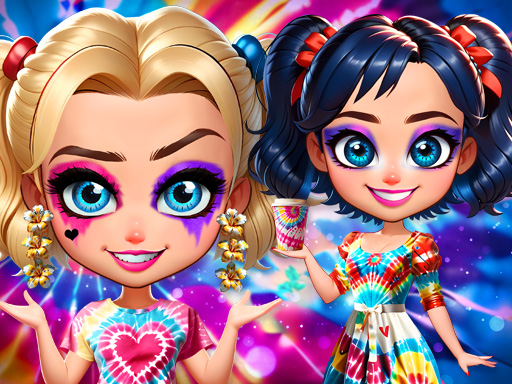
Two distinct characters provide different fashion inspirations. One character leans toward bold, confident looks with strong contrasts and vivid hues. The other prefers softer, imaginative combinations with gentle transitions and playful accents. Players can dress either character, which influences the types of outfits that feel natural. This duality adds a layer of decision-making without complicating the core activity. It also allows players to explore how personality can shape artistic choices. The characters themselves are presented in a cheerful, cartoon-like art style that matches the game's lighthearted tone.
Pattern Tools and Techniques
The game includes several pattern tools that mimic real tie-dye methods. Spirals create a classic swirl effect that radiates from a central point. Stripes add linear contrast, either horizontal or vertical, depending on how the player drags the dye. Splash effects produce random speckled patterns that look energetic and spontaneous. Players can layer these patterns on top of each other, building complexity step by step. The tools respond to touch or mouse clicks with smooth, immediate feedback. This makes the design process feel tactile and responsive, even on a screen.
Saving and Sharing Creations
Once an outfit is complete, players can save it to a personal gallery. This gallery acts as a portfolio of past designs, allowing for comparison and refinement over time. There is also an option to share finished looks with others, though the game does not specify how sharing works. The ability to revisit and tweak previous designs encourages iterative creativity. Players might start with a simple spiral pattern and later add stripes or change colors to see how the look evolves. This feature supports a gradual learning curve without pressure.
Accessibility and Audience
The controls are designed for simplicity, requiring only taps or clicks to apply colors and patterns. No reading or complex instructions are needed, making the game accessible to very young players and those unfamiliar with digital tools. The interface uses large icons and clear visual cues to guide actions. This low barrier to entry means the game can serve as a relaxing activity for anyone seeking a creative outlet. It does not include timers, scores, or competitive elements, which keeps the focus purely on artistic expression.


Comments
Sign in to leave a review
No account? Create one
No comments yet.